Fiji Hotel and Tourism Association, 27 November 2025 – Every so often, I am reminded that Fiji’s tourism industry does not operate in a bubble.
We are part of a much larger global ecosystem that shifts and adapts at a pace that would make most of our policymakers slightly dizzy. And while we pride ourselves on our natural warmth and the beauty of our islands, the world does not slow down to let us catch up. If anything, it is accelerating while whispering fiercely for us to keep up.
Which is precisely why the Fiji Hotel and Tourism Association (FHTA) has been making a deliberate effort to step outside our comfort zone, look outward, and learn from what other destinations are doing successfully. Not because we want to mimic anyone, but because there is real value in understanding what works, why it works, and how it might be adapted to our own unique context.
It helps our cause to be invited by global forum organisers who consider FHTA a respected tourism body whose insights shape policy dialogue as a credible voice for the Pacific, and whose participation adds weight to regional perspectives and strengthens Fiji’s visibility on the world stage.
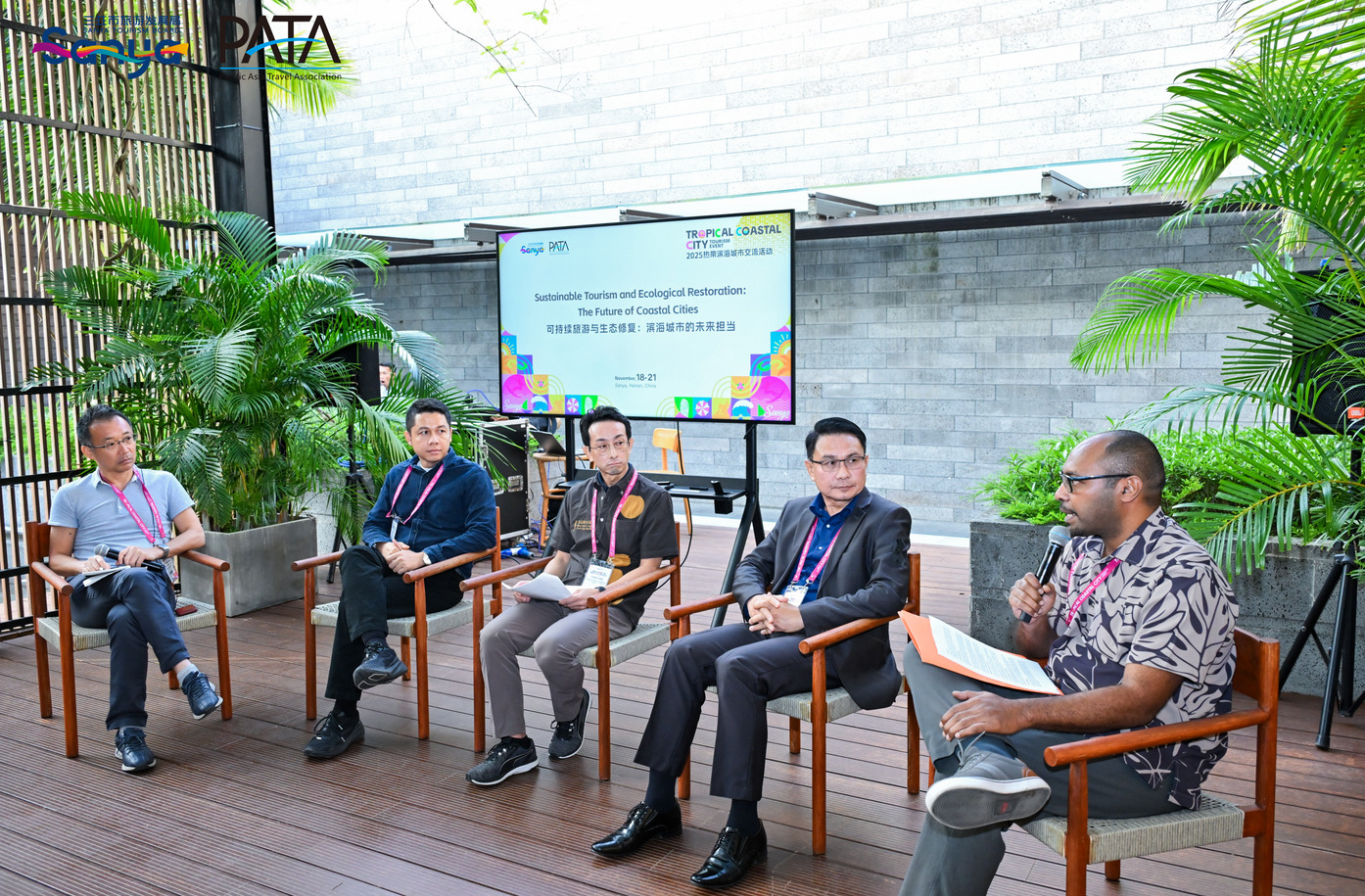
One of our staff recently represented both Fiji and the Association at the 2025 Tropical Coastal City Tourism Event in Sanya City, China. Organised by Sanya Tourism Board and supported by Pacific Asia Travel Association, we gained immensely from being there and returned with valuable insight on why these engagements take place globally. Our representative delivered a keynote address, took part in a panel
discussion, and spent several days engaging with tourism professionals from around the world, including colleagues from across the Pacific. These conversations were not academic or ceremonial. They were practical, grounded and sometimes confronting, precisely because they made clear how much the industry is evolving. It also became increasingly clear that Fiji has every opportunity to lead rather than follow, provided we are willing to keep learning and adapting.
One of the strongest impressions from these global exchanges is how fluid the idea of sustainability has become. For some destinations, it is about carbon reduction and renewable energy. For others, it is about food security, cultural integrity, or visitor management. The truth is that sustainability is no longer one thing. It is a toolkit that each country adapts according to its own needs, pain points, and natural advantages.
In my daily conversations with tourism stakeholders across Fiji, I hear the same sentiments. Sustainability is important, but it must be realistic and supported by pragmatic government policies. A small family-run resort in Kadavu will interpret sustainability very differently from a large integrated property in Denarau, and that is perfectly fine. Our task as an industry body is not to dictate a single approach but to encourage and guide operators to pursue sustainability in ways that align with their scale, their environment, affordability and their long-term ambitions.
These perspectives become richer when we’re immersed in international forums or regional gatherings that allow interaction with different experiences. We see how destinations with fewer natural assets than Fiji manage to create powerful tourism identities through innovation, niche experiences, and careful development. Also observing how major tourism economies are finding innovative ways to reduce overtourism and congestion, address the protection of fragile sites, and support local economies that might otherwise be left behind. These ideas translate directly to challenges we face at home.
Learning from others is both interesting and encouraged. We have countless off-the beaten-track locations that could host credible tourism ventures, from boutique eco retreats to community-driven marine tours, hiking circuits, wellness escapes, or heritage experiences. Many of these concepts are already being explored in other destinations with remarkable success. What they have mastered is the art of making small-scale tourism feel premium, meaningful, and authentically culturally rooted through supportive government policies that create opportunities. We can also do this, but it requires a level of coordination, support, and long-term planning that does not happen by accident.
We will continue to gather these insights, translate them for the local context, and advocate for policies that make innovation possible. Each time we engage with forums like these, we bring home perspectives that help us connect the dots between what travellers want, what operators can deliver, and where effective policies can support industry growth. Whether we are discussing workforce development, safety standards, environmental management, or digital engagement, we get a clearer picture of what is working elsewhere and how far ahead some destinations have already moved. More specifically, we get first-hand knowledge on how they got over challenges to succeed.
One clear example is the growing convergence between tourism and wellness. Around the world, wellness is no longer an isolated niche. It has become deeply integrated into mainstream travel behaviour, influencing everything from accommodation design to dining, activities, and transport. This shift is driven by travellers who are more conscious of their health, their emotional wellbeing, and their desire for restorative experiences – driven perhaps by a faster-paced world that is doing great damage to people’s mental and physical health. We already have the natural advantage to lead in this space. But to stay competitive, we need to understand how destinations are packaging wellness holistically, how they train staff, how they price these experiences, and how they measure success.
Another area where global learning is essential is visitor management. Popular destinations are running into very real pressures created by overcrowding. The solution has not been to reduce visitor numbers but to manage them differently through the development of new tourism corridors, investing in infrastructure for emerging areas, and encouraging private sector innovation. Many destinations have been able to distribute visitors more evenly and deliver better experiences for both travellers and residents – an approach Fiji must consider as our own numbers climb. If we want sustainable growth, we must diversify the geography of our tourism economy. This includes supporting new operators in rural or outer island areas, improving transport links, and ensuring that regulatory processes do not inadvertently frustrate small businesses trying to contribute to the industry.
And size does not matter either. Smaller destinations can pivot faster, experiment more freely, and implement changes without getting stuck in bureaucratic slow lanes. But alignment and a clear purpose are critical. These conversations help us refine that purpose, helping us identify gaps in training, regulation, and investment. They help us bring industry and government closer together around shared priorities. And they help us prepare for trends that will shape tourism for decades to come, rather than reacting when it is already too late.
The event in Sanya was one such reminder that Fiji is more respected internationally than we often realise. There is genuine interest in how we are preserving our culture, proudly managing our ocean space, competing with other, far larger destinations and focused on not losing what makes us unique. These are qualities that matter to travellers, especially in long-haul markets where authenticity and environmental responsibility are significant drivers of traveller decision-making. The world is watching how destinations balance growth and identity, and Fiji is gaining recognition and respect through setting a positive example.
Tourism is never static. It evolves with technology, with traveller expectations, with climate realities, and with cultural shifts. The destinations that thrive are those that stay curious, stay informed, and stay connected. Our commitment at FHTA is to ensure that every learning opportunity strengthens our industry’s ability to adapt and prosper.
Whether it is sustainability in its many forms, wellness, cultural preservation, emerging tourism markets, or visitor dispersion, we are here to help Fiji not just keep up, but get ahead.
The message from our latest international engagement was clear – we have the potential to lead in more areas than we currently imagine. But we must be willing to learn, collaborate, and innovate with the same confidence that travellers already place in us. And that is precisely what we intend to push for.
Fantasha Lockington – CEO, FHTA (Published in the Fiji Times on 27 November 2025)