Fiji Hotel and Tourism Association, 01 October 2026 – Over the past fortnight, we’ve looked closely at the gap between Fiji’s tourism growth and the systems supporting it, and then at the distance between funded projects and finished ones. Now we close this series somewhere slightly different, not with another case study, but with the question sitting underneath all of them. Tourism has carried this country through recovery and continues to finance a large share of its economic activity today. Government is right to pursue diversification into manufacturing, agriculture, ICT and other sectors, and it is genuinely hoped that ambition succeeds. But those sectors will take years to reach anything like tourism’s current scale. Until they do, tourism is still the engine paying many of today’s bills. The question worth asking plainly is this: if tourism is expected to keep carrying that weight through the transition, are we moving urgently enough on the infrastructure that keeps it moving?
It helps to understand why funding and delivery are not the same thing, because this often gets distorted in public conversation more than it should. A budget allocation is a commitment to begin a process, not a guarantee that construction starts the following week. Procurement, technical design, approvals, the mobilising of contractors, equipment and significant skilled labour take time. None of these stages is failures in themselves, and anyone who has managed a large project, public or private, knows this lifecycle is real and mostly unavoidable. The trouble starts when that lifecycle repeatedly stalls or restarts without anyone tracking why (and using their boot appropriately), and that is a different problem entirely from the lifecycle simply existing.
Part of what makes this harder in Fiji is something worth naming plainly. We live in a disaster-prone country, where planned capital works constantly compete with unavoidable emergencies. A cyclone damages a bridge. Flooding washes out a crossing or disrupts a community’s living conditions. A retaining wall fails, or an ageing road, bridge, water pipes or drain is unable to keep up with increasing use. None of these was on this year’s capital plan. Yet every one of them rightly demands funding, and no reasonable person would argue otherwise.
The consequence is that strategically important, long-planned projects lose momentum, not because they matter less, but because something more urgent requires the same crews, the same budget line, the same ministerial attention, right now. The emergency gets solved. The underlying constraint that made the original project necessary remains, quietly waiting its turn again.
This is not raised to excuse delay, but to describe the operating environment honestly; because only by naming it can we have a useful conversation about fixing it. The key point is that while we cannot plan for every contingency, government has only a finite pool of funds.
So, when readers say, “well, they should budget for these as well,” the reality is stark: in a country where emergencies are the rule, not the exception, the trade-off is not between good planning and bad planning, but between urgent survival and long-term progress.
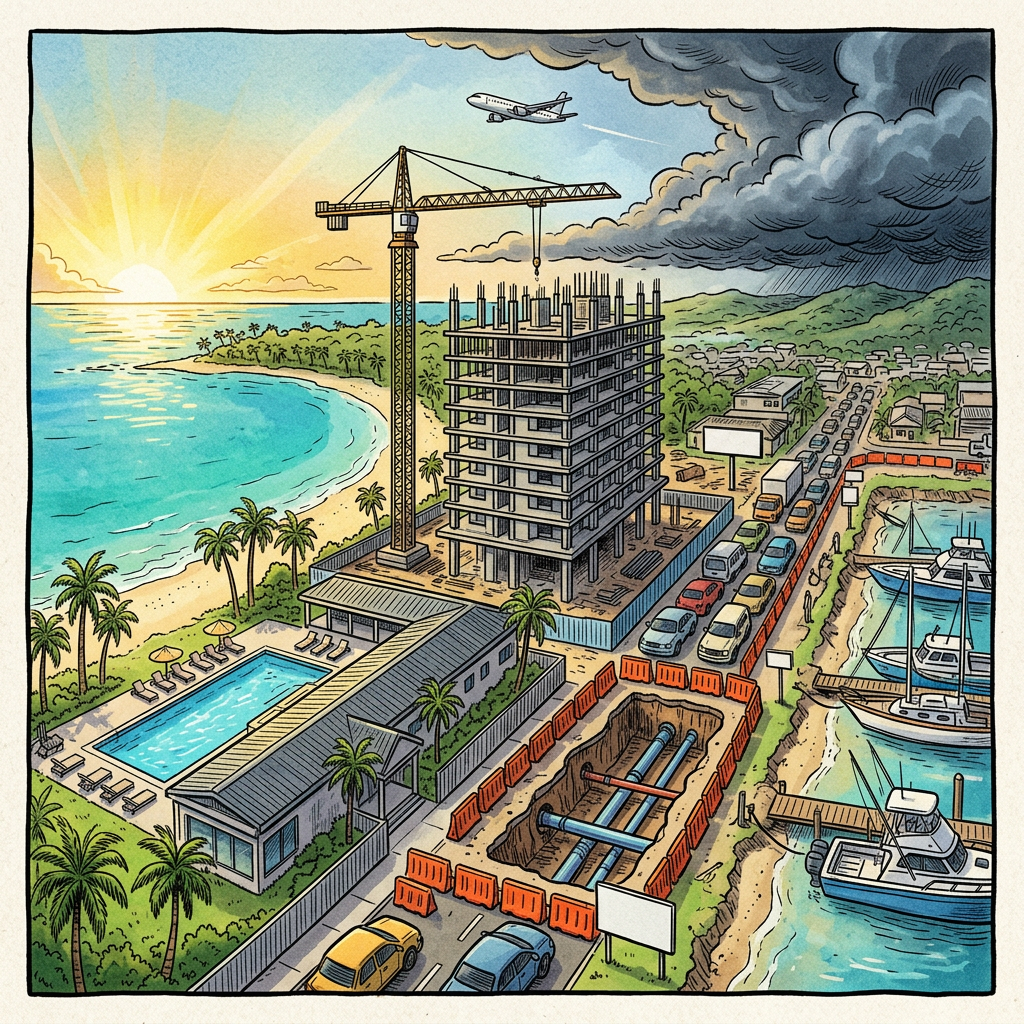
This is where tourism’s position genuinely differs from most other users of public infrastructure, and worth being direct about. Tourism and its vast connected supply chains do not simply use infrastructure. It amplifies the return on it. A completed airport corridor road does not just move more traffic; it moves the visitors an entire tourism economy depends on reaching their destination safely. Water and wastewater systems supporting a resort precinct are not just utilities; they are the difference between a development proceeding on schedule and one stalling at the approvals stage because a waste treatment plant cannot take another connection. Marina access is not just convenient for boat owners; it enables an entire marine tourism sector that generates tens of millions in direct spend annually and allows our island communities to access school, work, hospital and supermarkets. Reliable power and water are not background conditions for a new hotel; they are the precondition for the investment ever being made at all and will determine whether the developer’s original cost estimate stays within affordability range or scares potential investors away from running with their money.
Every completed piece of tourism-enabling infrastructure unlocks private investment that Government does not have to fund itself. The public dollar builds the platform. The private dollar builds the rooms, restaurants, vessels, land transfers, experiences and employment that sit on top of it. That is genuinely about as efficient a use of public capital as exists in this economy. A dollar spent finishing a trunk main or a treatment upgrade on schedule does not just fix a pipe. It clears the way for even more private equity that might otherwise sit on the sideline waiting for the constraint to lift. Delay does not just cost Government a completion date. It costs the country the multiplier that would have followed it. And that multiplier is the mechanism by which Government gains access to more revenue: every private investment triggered by completed infrastructure expands the tax base, strengthens customs and VAT collections, and generates employment contributions that flow back into public coffers.
Another funding announcement is not being called for. What would be beneficial is clearer delivery milestones attached to projects once they are funded, so progress, or the lack of it, is visible rather than something a business chamber has to describe from memory four years on. Transparent progress reporting would let the industry, and the public, see where a project genuinely sits rather than relying on a ministerial statement from a year ago being the last word anyone heard. Strategic, significant infrastructure deserves a form of protection within the delivery system, not immunity from emergencies; nobody is asking for that, but a mechanism that stops it quietly losing its place in the queue indefinitely every time something more urgent arrives. And prioritisation should be weighed by economic impact rather than simply how long a project has been sitting on a list. Because a project unlocking hundreds of millions in private investment and a project that happens to be older are not equally urgent just because both are overdue.
Fiji’s diversification agenda deserves every chance to succeed. But diversification is built on today’s economy and the pace we are delivering at now, not tomorrows. Until new sectors reach a scale comparable to tourism’s, tourism remains the country’s strongest engine of foreign exchange, employment, and tax revenue, carrying weight that other sectors are not yet positioned to share. Protecting that engine means treating the infrastructure beneath it with the same urgency as the investment rising visibly above it; not because tourism deserves special treatment, but because the return on getting this right, for tourism and for the diversification agenda both, is simply too large to leave sitting in a queue behind the next emergency. And that is the critical point: unless there is a whole-of-government understanding that development timelines must be delivered, supported, and progressed consistently, Fiji will never bring diversification to the scale required.
Fantasha Lockington – CEO, FHTA (Published in the Fiji Times on 01 October 2026)

Fiji Hotel and Tourism Association
The Voice of the Industry